

Introduction
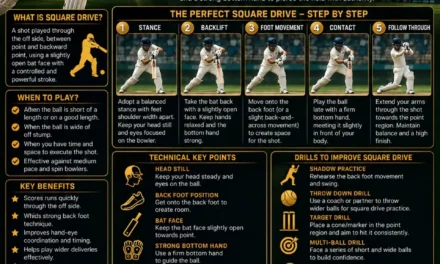
The Most Important Cricket Batting Shots is an important part of learning cricket, especially for players who are building their skills from the ground up. At a cricket academy, good development starts with understanding the game as well as practicing individual techniques. An introduction to drives, cuts, pulls, sweeps, flicks, and defensive strokes, with guidance on when to use them. The aim is not simply to perform one skill once, but to develop habits that can be repeated during training and trusted in a match.
Build the fundamentals first
Players often improve faster when they focus on simple movements before trying advanced techniques. Coaches can break the most important cricket batting shots into small parts and then connect those parts into one smooth action. Balance, body position, timing, awareness and control are useful foundations across cricket. A beginner should be comfortable repeating a basic movement before adding speed, power or complexity.
Practice with purpose
Effective practice should have a clear objective. Instead of repeating the same activity without feedback, set a small target for each session. For example, a player may focus on accuracy, clean contact, movement toward the ball, or making a good decision. Short sets with breaks can help maintain quality. Coaches can also change the difficulty gradually so that players learn to adapt rather than becoming comfortable only in one situation.
Use match situations
Cricket skills become more meaningful when players understand when to use them. Training can include realistic situations such as protecting a total, chasing runs, taking a new-ball spell, defending a partnership, or stopping a boundary. Match-based practice encourages communication and decision-making. It also helps young players understand that good cricket is often about choosing the right option rather than trying to make every action spectacular.
Common mistakes to avoid
One common mistake is trying to generate too much power too early. Another is changing technique repeatedly without giving the body enough time to learn a movement. Players should also avoid ignoring footwork, balance, recovery and communication. Mistakes are a normal part of development, so coaches should identify the reason for an error and give one or two practical corrections rather than overwhelming the player with instructions.
Academy takeaway
The best way to develop the most important cricket batting shots is to combine quality coaching, regular practice, physical preparation and match experience. Progress should be measured over time rather than from one session. Players who stay patient, listen to feedback and consistently work on fundamentals can build a stronger all-round game. A cricket academy provides the environment, but the player’s attitude toward learning is equally important.
Defensive strokes deserve special attention because they help a batter survive difficult periods. A forward defence can stop a good-length ball from reaching the fielders, while a back-foot defence can control a shorter delivery. Good defence is not passive; it is a skill that allows a batter to stay at the crease and wait for better scoring opportunities.
Players should learn shots progressively. Coaches can start with controlled feeds and focus on contact and balance before introducing faster bowling. Once a stroke is reliable, the player can practice placing it into different areas of the field. This develops the ability to score without depending entirely on power.
Shot selection should always consider risk. A boundary attempt may be appropriate when the ball is in the batter’s preferred area, but forcing a shot outside that area can create an easy chance. Smart batters understand both their strengths and the bowler’s plan.







Recent Comments